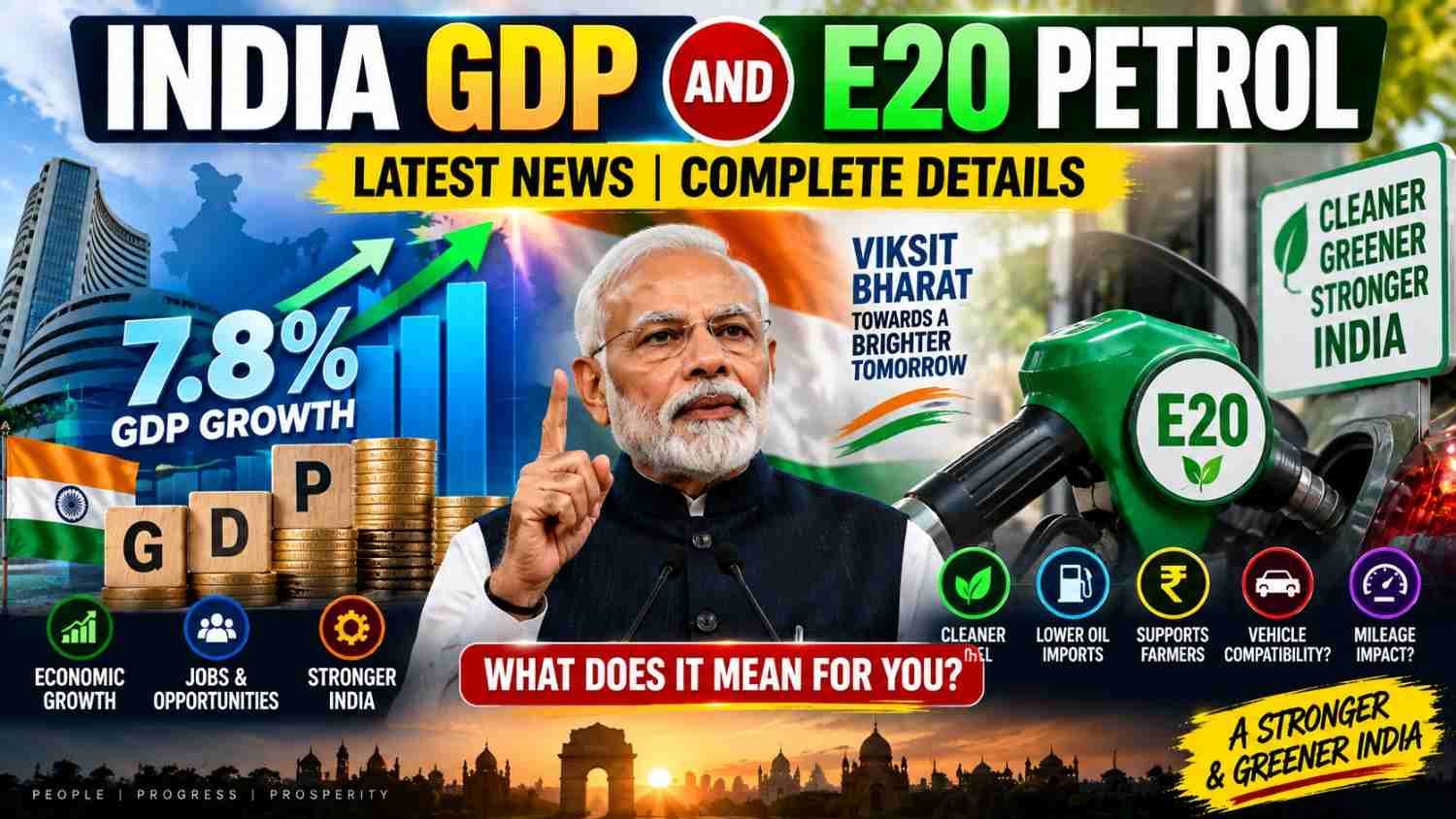
India GDP and E20 petrol have become important discussion topics in India because they are connected with economic growth, fuel prices, vehicle performance, energy security and household expenses. India’s latest GDP growth data has attracted attention after the economy recorded strong real growth in the April–June 2026 quarter. At the same time, E20 petrol has created a nationwide debate about mileage, vehicle compatibility, fuel efficiency and the future of petrol in India.
This article explains the latest India GDP and E20 petrol news in simple language, including GDP growth, the meaning of E20 petrol, its advantages and disadvantages, government policy, consumer concerns, economic impact and frequently asked questions.
India GDP and E20 petrol: Latest News Update
The latest India GDP and E20 petrol developments can be summarised in two parts:
- India’s real GDP growth was reported at 7.8% in the April–June 2026 quarter.
- E20 petrol remains a major policy and consumer issue because it contains up to 20% ethanol blended with petrol.
- The government has defended E20 petrol and highlighted its possible benefits for energy security, domestic ethanol production and reduction in crude-oil imports.
- Consumers have raised concerns about mileage reduction, especially in older cars, motorcycles and scooters.
- Chief Economic Adviser V. Anantha Nageswaran suggested that lower-blend petrol, such as E10, could be made available alongside E20 to reduce public concerns.
- There is currently no confirmed decision to immediately move beyond the E20 blending level.
India GDP and E20 petrol: What Is India’s Latest GDP Growth Rate?
India’s real GDP growth was reported at 7.8% for the April–June 2026 quarter. This means the Indian economy expanded by 7.8% compared with the same quarter of the previous year after adjusting for inflation.
The growth figure was stronger than several earlier expectations. The International Monetary Fund welcomed India’s economic performance and pointed to the strength of services activity and exports as important contributors.
However, the GDP number has also led to debate among economists and political commentators. Some analysts have questioned whether the revised calculation methods and changes in the comparison base make the headline growth rate difficult to interpret.
The government and official representatives have defended the data and stated that improvements in methodology, price information and data sources have strengthened the national accounts system.
India GDP and E20 petrol: Why Is the GDP Growth Figure Important?
GDP, or Gross Domestic Product, measures the value of goods and services produced within a country during a particular period.
A higher GDP growth rate can indicate:
- Stronger business activity.
- Higher production.
- Increased services-sector activity.
- More investment.
- Better export performance.
- Higher government revenue.
- Greater employment opportunities, although GDP growth does not automatically guarantee more jobs.
- Improved confidence among investors and businesses.
The reported 7.8% growth rate is important because India is attempting to maintain strong economic expansion while facing global risks, energy-price volatility, inflationary pressure and geopolitical uncertainty.
India GDP and E20 petrol: Why Is India’s GDP Data Being Discussed?
The latest GDP data has attracted attention for several reasons.
India GDP and E20 petrol: Revised GDP Calculation Method
India has updated its GDP calculation framework, including changes to the base year and the use of additional data sources. These changes are intended to make the measurement of economic activity more accurate and relevant to the present economy.
India GDP and E20 petrol: Comparison Base Effect
GDP growth is calculated by comparing one period with an earlier period. If the earlier period had unusually weak or revised data, the current growth rate may appear particularly high.
This is known as a base effect. A high growth rate does not always mean that every sector or every household is experiencing the same level of improvement.
India GDP and E20 petrol: Debate About Transparency
Some economists have requested greater clarity about the data sources, deflators and calculation methods used in the latest GDP estimates. The government has argued that the revised methodology improves the quality of national accounts.
Readers should understand that a debate about methodology does not automatically mean that the GDP figure is incorrect. It means that analysts are examining how the figure was calculated and how it should be interpreted.
India GDP and E20 petrol: What Is E20 Petrol?
E20 petrol is a fuel blend containing:
- Up to 20% ethanol.
- Around 80% petrol.
The letter E means ethanol, while the number 20 refers to the maximum ethanol percentage in the blend.
For example, one litre of E20 petrol may contain approximately:
- 800 millilitres of petrol.
- 200 millilitres of ethanol.
The actual composition may vary within permitted specifications.
India GDP and E20 petrol: Why Is India Promoting Ethanol Blending?
India imports a large share of its crude oil requirement. Ethanol blending is promoted as one way to reduce dependence on imported fossil fuels.
The main objectives include:
- Reducing crude-oil import dependence.
- Saving foreign exchange.
- Supporting domestic ethanol producers.
- Creating an additional market for agricultural products.
- Improving energy security.
- Supporting the biofuel industry.
- Reducing certain emissions compared with conventional petrol.
- Encouraging the development of alternative fuels.
Ethanol can be produced from feedstocks such as sugarcane, molasses, maize and other approved agricultural sources.
India GDP and E20 petrol: When Did E20 Petrol Become a Major Policy Issue?
India accelerated its ethanol-blending programme over the past few years. The country reached the 20% ethanol-blending milestone earlier than the original target that had been discussed for the end of the decade.
E20 petrol became a major public issue when more consumers began reporting possible mileage changes in cars, motorcycles and scooters. The discussion expanded through social media, automotive forums, news reports and consumer groups.
The government has stated that E20 is scientifically validated and safe for compatible vehicles. Automotive manufacturers, however, have different recommendations depending on the vehicle’s model year, engine design and fuel-system specifications.
India GDP and E20 petrol: Does E20 Petrol Reduce Mileage?
E20 petrol contains less energy per litre than petrol with a lower ethanol percentage. Because of this, some vehicles may deliver slightly lower mileage when using E20.
The exact impact depends on:
- Vehicle age.
- Engine design.
- Fuel-injection system.
- Engine calibration.
- Vehicle maintenance.
- Driving style.
- Traffic conditions.
- Tyre pressure.
- Air-conditioning use.
- Fuel quality.
- Ethanol compatibility of the vehicle.
A mileage reduction should not be assumed to be identical for every car or motorcycle.
Older vehicles may experience more noticeable effects if they were not designed or calibrated for higher ethanol blends. Newer vehicles that are certified as E20-compatible are generally better prepared for the fuel.
India GDP and E20 petrol: Is E20 Petrol Safe for Vehicles?
E20 petrol is intended for vehicles that are compatible with the blend. Many newer vehicles are being designed, tested or certified for E20 use.
However, vehicle owners should check:
- The owner’s manual.
- The fuel sticker or label.
- The manufacturer’s official website.
- The authorised service centre.
- The vehicle’s model year and compatibility information.
Owners should not rely only on social-media claims. A vehicle’s actual compatibility depends on the manufacturer’s specifications.
If a vehicle is not approved for E20, regular use may increase the risk of fuel-system or material-compatibility problems over time. Consumers should obtain advice from the manufacturer before using a higher ethanol blend in an older vehicle.
India GDP and E20 petrol: What Are the Main Advantages of E20 Petrol?
India GDP and E20 petrol: Lower Crude-Oil Import Dependence
Domestic ethanol can partially replace petrol derived from imported crude oil. This may help reduce India’s dependence on international oil markets.
India GDP and E20 petrol: Foreign Exchange Savings
If ethanol replaces a portion of imported petroleum products, India may save foreign exchange. The actual savings depend on crude-oil prices, ethanol production costs, blending levels and supply-chain expenses.
India GDP and E20 petrol: Support for Farmers and Ethanol Producers
Ethanol production can create demand for approved agricultural feedstocks and support industries connected with sugar, grain processing and biofuel manufacturing.
India GDP and E20 petrol: Energy Security
Greater use of domestically produced ethanol may provide an additional fuel source and reduce exposure to international supply disruptions.
India GDP and E20 petrol: Environmental Benefits
Ethanol blending may reduce certain lifecycle emissions compared with conventional petrol, depending on how the ethanol is produced, transported and processed.
The environmental benefit is not identical in every situation and should be assessed across the complete production cycle.
India GDP and E20 petrol: What Are the Disadvantages of E20 Petrol?
India GDP and E20 petrol: Possible Mileage Reduction
Because ethanol has lower energy content per litre than petrol, some vehicles may show lower fuel efficiency.
India GDP and E20 petrol: Older Vehicle Compatibility
Some older vehicles may not have fuel-system components designed for higher ethanol blends.
India GDP and E20 petrol: Fuel Price Concerns
Consumers have questioned why E20 petrol is not always sold at a noticeably lower price despite ethanol being a domestic fuel component.
The final retail price is affected by crude-oil prices, taxes, transportation, dealer margins, blending costs, refining costs and government policy.
India GDP and E20 petrol: Water Absorption and Storage Issues
Ethanol is hygroscopic, meaning it can absorb moisture. Proper fuel handling, storage and vehicle-system design are important to reduce possible fuel-quality problems.
India GDP and E20 petrol: Different Effects on Different Vehicles
A modern E20-compatible vehicle and an older non-compatible vehicle may not experience the same result. Therefore, broad claims that E20 will damage every vehicle are not accurate.
India GDP and E20 petrol: What Has the Government Said About E20 Fuel?
The government has defended the E20 programme and stated that it offers economic, environmental and energy-security benefits.
Government arguments include:
- E20 has been tested for compatible vehicles.
- Ethanol blending can reduce crude-oil imports.
- Domestic ethanol production supports the agricultural economy.
- E20 can contribute to energy diversification.
- The policy supports India’s long-term biofuel goals.
The government has also rejected several viral claims about E20 petrol, including exaggerated claims that the fuel automatically damages every vehicle or creates unusual problems such as attracting ants because of sugar residue.
Consumers should verify viral claims through official government notices, oil companies and vehicle manufacturers.
India GDP and E20 petrol: What Did the Chief Economic Adviser Say?
Chief Economic Adviser V. Anantha Nageswaran suggested that the government could consider offering a lower ethanol blend, such as E10, alongside E20.
The proposal was presented as a way to address consumer concerns over mileage and vehicle compatibility.
This does not mean that a nationwide E10 option has already been introduced everywhere. It was a policy suggestion intended to reduce public anxiety and provide consumers with more choice.
The availability of different fuel blends would depend on government decisions, oil marketing companies, fuel infrastructure and applicable regulations.
India GDP and E20 petrol: Will E10 Petrol Return to Fuel Stations?
At present, consumers should not assume that E10 petrol is available at every fuel station.
The availability of lower-blend petrol depends on:
- Government policy.
- Oil marketing company supply arrangements.
- Fuel station infrastructure.
- Regional availability.
- Vehicle compatibility rules.
- Official implementation decisions.
Consumers should ask the fuel station or oil marketing company about the ethanol blend before purchasing fuel.
India GDP and E20 petrol: Is E20 Petrol Cheaper Than Normal Petrol?
E20 petrol is not automatically cheaper at the retail level.
The final price depends on several factors:
- International crude-oil prices.
- Domestic ethanol prices.
- Central and state taxes.
- Refining costs.
- Transportation costs.
- Dealer commissions.
- Marketing margins.
- Currency exchange rates.
- Government pricing decisions.
Although ethanol can reduce crude-oil dependence, the retail price of E20 is not determined only by the cost of ethanol.
India GDP and E20 petrol: How Does E20 Petrol Affect the Indian Economy?
E20 petrol can influence the Indian economy in several ways.
India GDP and E20 petrol: Impact on the Oil Import Bill
If ethanol replaces a portion of petrol made from imported crude oil, the country may reduce its oil import requirement.
India GDP and E20 petrol: Impact on Agriculture
Ethanol demand can support agricultural supply chains, but it also requires careful management of food security, water use, crop choices and procurement prices.
India GDP and E20 petrol: Impact on Manufacturing
The ethanol programme supports investment in distilleries, storage facilities, transport systems and fuel-blending infrastructure.
India GDP and E20 petrol: Impact on Consumers
Consumers may face changes in mileage, maintenance requirements and fuel expenses depending on their vehicle’s compatibility.
India GDP and E20 petrol: Impact on Inflation
Fuel costs affect transportation and logistics. Changes in petrol prices, mileage or crude-oil prices can influence household budgets and business costs.
India GDP and E20 petrol: How Are GDP Growth and E20 Fuel Connected?
GDP growth and E20 petrol are connected through energy, production and consumer spending.
A strong economy requires:
- Reliable energy supplies.
- Affordable transportation.
- Stable fuel availability.
- Industrial production.
- Efficient logistics.
- Consumer purchasing power.
E20 petrol may support energy security and reduce crude-oil dependence, but the transition also needs to consider vehicle compatibility, consumer costs and infrastructure.
If E20 reduces import dependence without creating major cost pressures, it may support economic resilience. If consumers face significant mileage losses or vehicle repair costs, the transition may create additional financial pressure for some households.
India GDP and E20 petrol: What Should Vehicle Owners Do?
Vehicle owners should follow these practical steps:
- Check whether the vehicle is E20-compatible.
- Read the owner’s manual.
- Contact the authorised service centre if the model year is unclear.
- Maintain correct tyre pressure.
- Replace air and fuel filters according to the service schedule.
- Avoid relying on unverified social-media claims.
- Keep fuel receipts if unusual performance problems occur.
- Report suspected fuel-quality issues to the fuel station and oil company.
- Do not modify the fuel system without professional advice.
- Compare mileage over several full-tank refills rather than judging from one short trip.
India GDP and E20 petrol: How Can Consumers Check Fuel Compatibility?
Consumers can check compatibility through:
- The vehicle’s owner’s manual.
- The manufacturer’s official website.
- The fuel label near the fuel cap.
- The vehicle purchase documents.
- An authorised dealership.
- The manufacturer’s customer-care service.
A vehicle’s registration year alone may not always provide the complete answer. The exact engine and model specification are more important.
India GDP and E20 petrol: Important Facts About GDP Growth
The following points are important when reading GDP news:
- Real GDP is adjusted for inflation.
- Nominal GDP is measured at current prices.
- Quarterly GDP figures can be revised.
- GDP growth does not measure income equality.
- GDP growth does not automatically show the financial condition of every family.
- Strong services growth can raise the overall GDP rate even when some sectors face difficulties.
- Base effects can influence year-on-year growth.
- GDP data should be read along with inflation, employment, consumption, investment and industrial production.
India GDP and E20 petrol: What Are the Main Challenges Ahead?
The major challenges include:
- Maintaining strong GDP growth.
- Controlling inflation.
- Managing crude-oil price volatility.
- Improving job creation.
- Supporting rural demand.
- Ensuring affordable transportation.
- Expanding E20-compatible vehicle coverage.
- Providing clear information to consumers.
- Maintaining ethanol supply.
- Balancing fuel security with food and water requirements.
- Improving transparency in economic data.
- Ensuring that fuel policy does not create unnecessary financial pressure on vehicle owners.
India GDP and E20 petrol: Future Outlook
India’s economic outlook will depend on domestic consumption, investment, exports, government spending, inflation, interest rates and global conditions.
For E20 petrol, the future will depend on:
- Vehicle compatibility.
- Ethanol production capacity.
- Fuel pricing.
- Government policy.
- Consumer acceptance.
- Availability of lower-blend alternatives.
- Research into flex-fuel and alternative-fuel vehicles.
- Development of electric, hybrid, CNG and other mobility options.
E20 petrol is likely to remain an important part of India’s energy policy, but public communication and consumer choice will be important for a smooth transition.
India GDP and E20 petrol: Key Takeaways
The most important points are:
- India’s real GDP growth was reported at 7.8% for April–June 2026.
- The GDP figure has attracted both positive attention and debate about methodology.
- E20 petrol contains up to 20% ethanol blended with petrol.
- E20 is intended to reduce crude-oil dependence and support domestic ethanol production.
- Mileage impact varies by vehicle and driving conditions.
- Older vehicles may not be suitable for E20.
- Newer E20-compatible vehicles are designed for the blend.
- The government has defended E20 petrol.
- The Chief Economic Adviser suggested considering lower-blend petrol alongside E20.
- Consumers should check official vehicle compatibility information.
- No website can guarantee Google ranking or AdSense approval, but accurate, original and useful content improves publishing quality.
India GDP and E20 petrol: Frequently Asked Questions
India GDP and E20 petrol: What is India’s latest GDP growth rate?
India’s real GDP growth was reported at 7.8% for the April–June 2026 quarter.
India GDP and E20 petrol: What does E20 mean?
E20 means petrol blended with up to 20% ethanol.
India GDP and E20 petrol: Is E20 safe for all vehicles?
No. E20 should be used according to the vehicle manufacturer’s compatibility instructions.
India GDP and E20 petrol: Does E20 reduce mileage?
It may reduce mileage in some vehicles because ethanol contains less energy per litre than petrol. The actual impact varies.
India GDP and E20 petrol: Is E20 cheaper than normal petrol?
Not necessarily. Retail fuel prices depend on crude oil, taxes, blending costs, transportation and other factors.
India GDP and E20 petrol: Can older vehicles use E20?
Some older vehicles may not be designed for E20. Owners should check with the manufacturer or authorised service centre.
India GDP and E20 petrol: Why is India promoting ethanol blending?
The main reasons include reducing crude-oil imports, saving foreign exchange, supporting domestic ethanol production and improving energy security.
India GDP and E20 petrol: Will E10 petrol be available again?
A lower-blend option has been suggested by the Chief Economic Adviser, but consumers should wait for official implementation details and check local availability.
India GDP and E20 petrol: Does GDP growth benefit every household equally?
No. GDP is an overall economic measure. Household income, employment, inflation and regional conditions can vary significantly.