Published: 12 October 2026
Category: India News and Political Updates
Location: New Delhi, India
Rahul Gandhi Supreme Court March 2026: Latest News
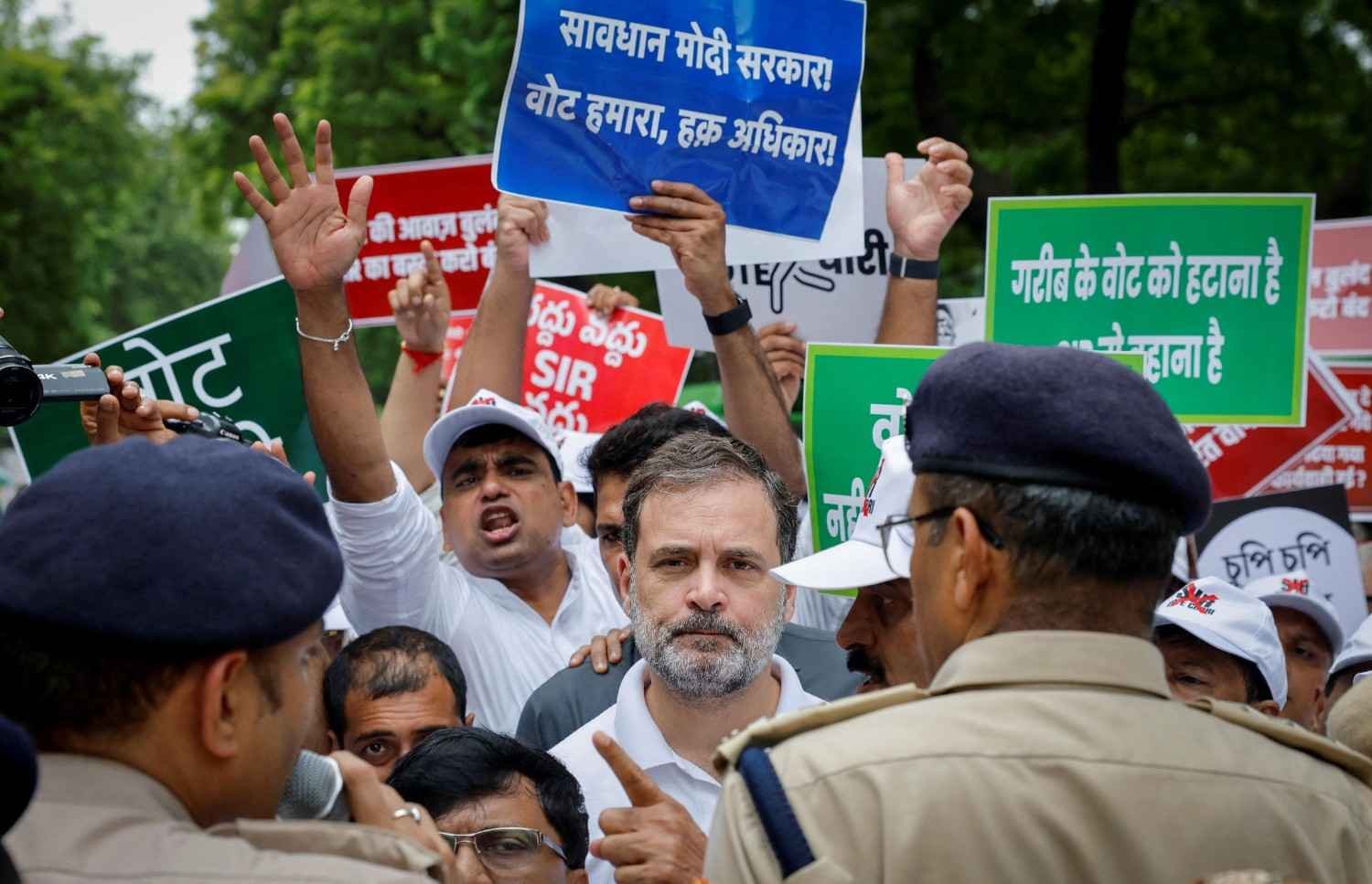
Congress leader and Leader of the Opposition in the Lok Sabha Rahul Gandhi led a march by opposition leaders towards the Supreme Court of India on Monday, 12 October 2026. The demonstration was organised to protest against alleged irregularities in the revision of electoral rolls and to demand action against Chief Election Commissioner Gyanesh Kumar.
The march involved leaders and supporters of several opposition parties belonging to the INDIA bloc. The demonstration followed days of political protests over the Election Commission’s Special Intensive Revision (SIR) of voter lists.
The opposition has alleged that the electoral-roll revision could exclude eligible voters and has questioned the transparency of the process. It has also demanded Kumar’s resignation and sought judicial scrutiny of the Election Commission’s actions.
The procession encountered police barricades on Bhagwan Das Road in central Delhi. Although the march was stopped short of its intended destination, lawyers representing the opposition leaders filed a petition in the Supreme Court concerning the disputed electoral-roll revision.
The developments have intensified the political debate over electoral transparency, the independence of constitutional institutions and citizens’ voting rights.
The Election Commission has rejected allegations that its actions favour any political party. The legal questions raised by the opposition remain subject to judicial examination.
Rahul Gandhi Supreme Court March 2026: What Happened on 12 October?
The march took place in New Delhi on Monday as part of a wider opposition campaign against the Special Intensive Revision of electoral rolls.
Rahul Gandhi and other opposition leaders had announced their intention to approach the Supreme Court after the Chief Justice of India declined their request for an administrative meeting concerning the controversy.
The procession moved through central Delhi amid heavy security arrangements. Police personnel established barricades along the route, and the demonstration was stopped on Bhagwan Das Road before the leaders could proceed as planned.
The march drew participation from Congress leaders, opposition MPs, political activists and supporters of other parties.
During the day, the opposition also pursued a legal route. A petition challenging aspects of the electoral-roll revision was filed in the Supreme Court on behalf of Rahul Gandhi and other opposition leaders.
The day’s developments therefore involved two related but distinct actions: a political demonstration in Delhi and a legal challenge to the Election Commission’s electoral-roll process.
Reports from Reuters and The Indian Express published on 12 October documented the march, the police restrictions and the filing of the petition.
Rahul Gandhi Supreme Court March 2026: Why Did the Opposition Organise the Protest?
The principal issue behind the demonstration is the Special Intensive Revision of electoral rolls.
An electoral roll is the official register of people eligible to vote in an election. The Election Commission periodically undertakes revision exercises to maintain accurate voter records.
The opposition has raised concerns about whether the latest revision has resulted in eligible citizens being removed from voter lists without sufficient safeguards.
Its principal concerns include:
- The possibility of eligible voters being excluded from electoral rolls.
- The transparency of the voter-verification process.
- The procedures used to remove or correct voter entries.
- Whether affected citizens receive adequate notice and an opportunity to challenge errors.
- The need for independent scrutiny of disputed deletions.
Opposition leaders have described the controversy as an issue of electoral integrity and democratic accountability.
However, allegations of deliberate or politically motivated voter deletion must be distinguished from verified findings. The existence of a dispute does not, by itself, establish that electoral manipulation has occurred.
The Election Commission maintains that electoral-roll revisions are intended to remove ineligible entries and maintain accurate records. The opposition disputes aspects of the process and is seeking judicial intervention.
The Supreme Court’s consideration of the legal challenge may help clarify the issues raised by the petitioners.
Rahul Gandhi Supreme Court March 2026: What Is the SIR Voter List Controversy?
SIR stands for Special Intensive Revision.
It refers to an exercise conducted by electoral authorities to review and update voter lists. Such exercises are intended to ensure that electoral rolls accurately reflect eligible voters.
The process can involve verification of voter details, identification of duplicate entries, updates following changes of residence and the removal of entries that no longer meet eligibility requirements.
The current controversy concerns whether the revision process has adequately protected eligible voters from being wrongly excluded.
The opposition has questioned the scale and implementation of the changes and has sought an independent examination of the process.
Reuters reported on 12 October that more than 130 million names had been removed from voter lists during the wider revision exercise. The report attributed the removals to categories including deceased individuals, people who had relocated and individuals who could not be traced.
These figures relate to the wider electoral-roll revision, not a finding that more than 130 million eligible voters were unlawfully removed.
The Election Commission has denied favouring any political party and has stated that people whose names were wrongly deleted can seek re-enrolment.
The central issue is whether the revision process has operated lawfully, accurately and with sufficient procedural safeguards.
Rahul Gandhi Supreme Court March 2026: What Did Rahul Gandhi Demand?
Rahul Gandhi and opposition leaders have called for greater accountability from the Election Commission and Chief Election Commissioner Gyanesh Kumar.
Their demands include:
1. Action concerning the Chief Election Commissioner
The opposition has demanded Kumar’s resignation, alleging that the handling of electoral-roll revisions has undermined public confidence in the electoral process.
2. Suspension or reconsideration of the SIR exercise
The petitioners have challenged the revision process and sought interim relief while the legal questions are examined.
3. Greater transparency
Opposition leaders want greater access to relevant records and explanations concerning voter-list changes.
4. Independent scrutiny
The petition seeks an audit of voter deletions and safeguards against the removal of names without appropriate notice and an opportunity to be heard.
5. Protection of voting rights
The opposition argues that electoral procedures must protect eligible citizens from wrongful exclusion.
These demands represent the position of the petitioners. Whether the Court accepts any of the requested measures will depend on the legal proceedings and the evidence presented.
Rahul Gandhi Supreme Court March 2026: Which Opposition Leaders Participated?
The march brought together prominent members of the INDIA opposition bloc.
Reported participants included:
- Rahul Gandhi of the Indian National Congress.
- Mallikarjun Kharge, Congress president.
- Priyanka Gandhi Vadra of the Congress.
- Akhilesh Yadav of the Samajwadi Party.
- Tejashwi Yadav of the Rashtriya Janata Dal.
- Saugata Roy of the Trinamool Congress.
- Supriya Sule of the Nationalist Congress Party (Sharadchandra Pawar).
- Sanjay Raut of Shiv Sena (Uddhav Balasaheb Thackeray).
- D. Raja of the Communist Party of India.
- M. A. Baby of the Communist Party of India (Marxist).
Other opposition MPs and political activists also joined the demonstration.
The participation of leaders from multiple parties highlighted the opposition’s attempt to present the electoral-roll dispute as a broader democratic issue rather than a controversy limited to the Congress.
However, the parties involved retain their own political positions, and their participation does not establish that every allegation made during the protest is correct.
Rahul Gandhi Supreme Court March 2026: Why Did Police Stop the March?
Police barricades were placed along the procession’s route through central Delhi.
The march was stopped on Bhagwan Das Road, preventing the group from proceeding as planned towards the Supreme Court.
The security arrangements came amid several days of demonstrations, preventive detentions and restrictions on public movement in the capital.
Authorities have faced pressure to maintain public order and manage large gatherings. Opposition leaders, meanwhile, have criticised restrictions that they say impede peaceful political expression.
The wider dispute has raised questions about the proportionality of security measures, the right to peaceful assembly and the practical arrangements governing demonstrations near sensitive public institutions.
The precise legal basis for individual restrictions and any related judicial directions should be assessed using official orders and court records.
The fact that a procession was stopped does not, by itself, determine whether the action was lawful. That assessment depends on the applicable rules and the circumstances.
Rahul Gandhi Supreme Court March 2026: Supreme Court Petition Filed
An important development on 12 October was the filing of a petition challenging aspects of the electoral-roll revision.
The petition was brought on behalf of Rahul Gandhi and other opposition leaders, including Mallikarjun Kharge and Akhilesh Yadav.
According to reports published on Monday, the petition raises concerns about alleged irregularities in the SIR process and seeks judicial intervention.
The reported requests include scrutiny of voter deletions, greater disclosure of relevant records and safeguards for citizens whose names may have been removed incorrectly.
The petition also seeks interim relief concerning the revision process.
It is important to distinguish the filing of a petition from a judicial decision. The petitioners’ claims have not automatically become established facts simply because the matter has been brought before the Court.
The next significant development will be the Court’s consideration of the application and any directions it issues.
Reuters reported on 12 October that a hearing was expected on Tuesday, 13 October 2026. Readers should check the latest court reporting for confirmation of the hearing and its outcome.
Rahul Gandhi Supreme Court March 2026: Why Did the Chief Justice Decline a Meeting?
Before the march, opposition leaders had sought a meeting with Chief Justice of India Surya Kant to raise concerns about the Election Commission, protest-related detentions and restrictions affecting public movement.
The Chief Justice declined the requested administrative meeting.
According to The Indian Express, the Chief Justice explained that the issues raised were already before the Court and that discussing pending cases through an administrative meeting would be inconsistent with judicial propriety and the separation of powers.
He indicated that the appropriate route was to invoke the Court’s judicial powers through the established legal process.
The distinction is important: declining an administrative meeting does not mean that the Court has rejected the legal claims. It means that the concerns should be addressed through appropriate judicial procedures.
The opposition subsequently pursued that route by filing a petition.
Rahul Gandhi Supreme Court March 2026: Election Commission’s Position
The Election Commission is responsible for administering elections and maintaining electoral rolls under India’s constitutional and legal framework.
In response to the wider controversy, the Commission has denied allegations of political favouritism.
Its position is that electoral-roll revision is intended to improve the accuracy of voter records by identifying ineligible entries and updating information.
The Commission has also indicated that people whose names have been wrongly deleted can seek re-enrolment through the applicable procedures.
The opposition, however, has questioned whether those procedures provide adequate protection against wrongful exclusion and has sought greater transparency.
The dispute therefore involves competing claims about the implementation and consequences of the revision process.
A complete assessment will require examination of the relevant records, the applicable legal rules and any findings made by the Court.
Rahul Gandhi Supreme Court March 2026: BJP and Government Reaction
The BJP has criticised the opposition’s campaign, arguing that the protests undermine confidence in constitutional institutions and legitimate electoral processes.
BJP leaders have also portrayed the demonstrations as part of the opposition’s political effort to challenge the government.
The opposition rejects that characterisation and says it is seeking electoral transparency and accountability.
The disagreement reflects a wider political divide over the Election Commission’s actions and the revision of voter lists.
For readers, it is important to distinguish between the political arguments advanced by each side and findings established through official records or judicial proceedings.
Neither an accusation by the opposition nor a rebuttal by the ruling party should be treated as conclusive evidence without further verification.
Rahul Gandhi Supreme Court March 2026: Impact on Delhi Traffic and Metro Services
The demonstrations led to additional security measures and disruption in parts of central Delhi.
Reuters reported that six metro stations were closed for approximately 11 hours and that traffic restrictions were imposed along several routes.
These measures affected the movement of commuters and people travelling through the capital.
The exact status of individual roads and metro stations may change as authorities review the security situation.
People travelling through central Delhi should consult official advisories before setting out.
For traffic updates, check the Delhi Traffic Police’s official communications.
For metro services, consult the Delhi Metro Rail Corporation’s announcements.
Earlier reports should not be treated as confirmation that restrictions remain in place.
Rahul Gandhi Supreme Court March 2026: What Happens Next?
The next stage of the controversy will depend on legal proceedings and further decisions by the political parties involved.
Several developments will be important to follow.
1. Supreme Court hearing
A hearing was expected on 13 October 2026, according to reporting published on 12 October. The Court’s actual schedule and any subsequent order should be verified before publication.
2. Examination of the SIR process
The petitioners are seeking scrutiny of the electoral-roll revision, including safeguards concerning deleted voter entries.
3. Election Commission response
Further explanations or legal submissions from the Commission could clarify its position on the issues raised.
4. Opposition campaign
Opposition parties may continue political demonstrations and public outreach concerning electoral transparency.
5. Public access to voter-registration procedures
Eligible citizens concerned about their enrolment status should use official Election Commission services and contact the relevant electoral registration authorities.
These are areas to watch, not predictions about the outcome of the case.
Rahul Gandhi Supreme Court March 2026: What Should Voters Know?
The controversy highlights the importance of checking voter-registration details through official sources.
Citizens should:
- Check whether their names appear on the relevant electoral roll.
- Follow official procedures if their details are incorrect or their names are missing.
- Keep the documents required by the applicable registration process.
- Consult the Election Commission or the relevant electoral registration officer for guidance.
- Avoid relying on unverified social-media claims about voter deletions.
The Election Commission’s official website provides information about voter services and registration procedures.
Citizens should also remember that claims about the scale or intent of voter deletions need to be evaluated against reliable evidence.
Rahul Gandhi Supreme Court March 2026: Frequently Asked Questions
1. Why did Rahul Gandhi march towards the Supreme Court?
Rahul Gandhi led opposition leaders in a march over alleged irregularities in the Special Intensive Revision of electoral rolls. The opposition also demanded action against Chief Election Commissioner Gyanesh Kumar.
2. When did Rahul Gandhi’s Supreme Court march take place?
The march took place on Monday, 12 October 2026, in New Delhi.
3. Did police stop Rahul Gandhi’s march?
Yes. Police barricades stopped the procession on Bhagwan Das Road in central Delhi before it could proceed as planned towards the Supreme Court.
4. Was a petition filed in the Supreme Court?
Yes. Lawyers filed a petition on behalf of Rahul Gandhi and other opposition leaders challenging aspects of the electoral-roll revision.
5. What is the SIR voter-list controversy?
The controversy concerns the Special Intensive Revision of electoral rolls. Opposition parties allege that the process risks excluding eligible voters and have sought greater transparency and judicial scrutiny. The Election Commission denies political favouritism.
6. Why does the opposition want Gyanesh Kumar to resign?
Opposition leaders have criticised the handling of the voter-list revision and argue that the Election Commission must be held accountable. Their demand for resignation is a political position, not a judicial finding of wrongdoing.
7. Did the Chief Justice refuse to consider the issue?
The Chief Justice declined an administrative meeting with opposition leaders, explaining that pending matters should be pursued through judicial procedures. The opposition subsequently filed a petition.
8. When will the Supreme Court hear the petition?
Reports published on 12 October indicated that a hearing was expected on Tuesday, 13 October 2026. The latest court schedule should be checked for confirmation.
9. How can citizens check their voter-registration status?
Citizens can consult the Election Commission of India’s official website and voter services to check registration details and find the applicable procedures for corrections or enrolment.
10. Is the voter-list controversy resolved?
No final resolution should be assumed. The opposition has raised allegations and sought judicial intervention, while the Election Commission has defended its process. The legal position will depend on subsequent proceedings and any official findings.
Rahul Gandhi Supreme Court March 2026: Conclusion
Rahul Gandhi’s Supreme Court march on 12 October 2026 has brought electoral transparency and the revision of voter lists back into the centre of India’s political debate.
The demonstration was organised by opposition leaders who questioned the Special Intensive Revision process and demanded accountability from Chief Election Commissioner Gyanesh Kumar.
Although police barricades stopped the procession on Bhagwan Das Road, the opposition also pursued a legal challenge through a petition filed in the Supreme Court.
The case raises important questions about electoral administration, voter-registration safeguards and the procedures available to citizens who believe they have been wrongly excluded from electoral rolls.
The opposition’s allegations remain contested, and the Election Commission has denied political favouritism. The Court’s examination of the petition will be an important next development.
Readers should follow verified updates from the Supreme Court, the Election Commission and credible news organisations as the matter progresses.