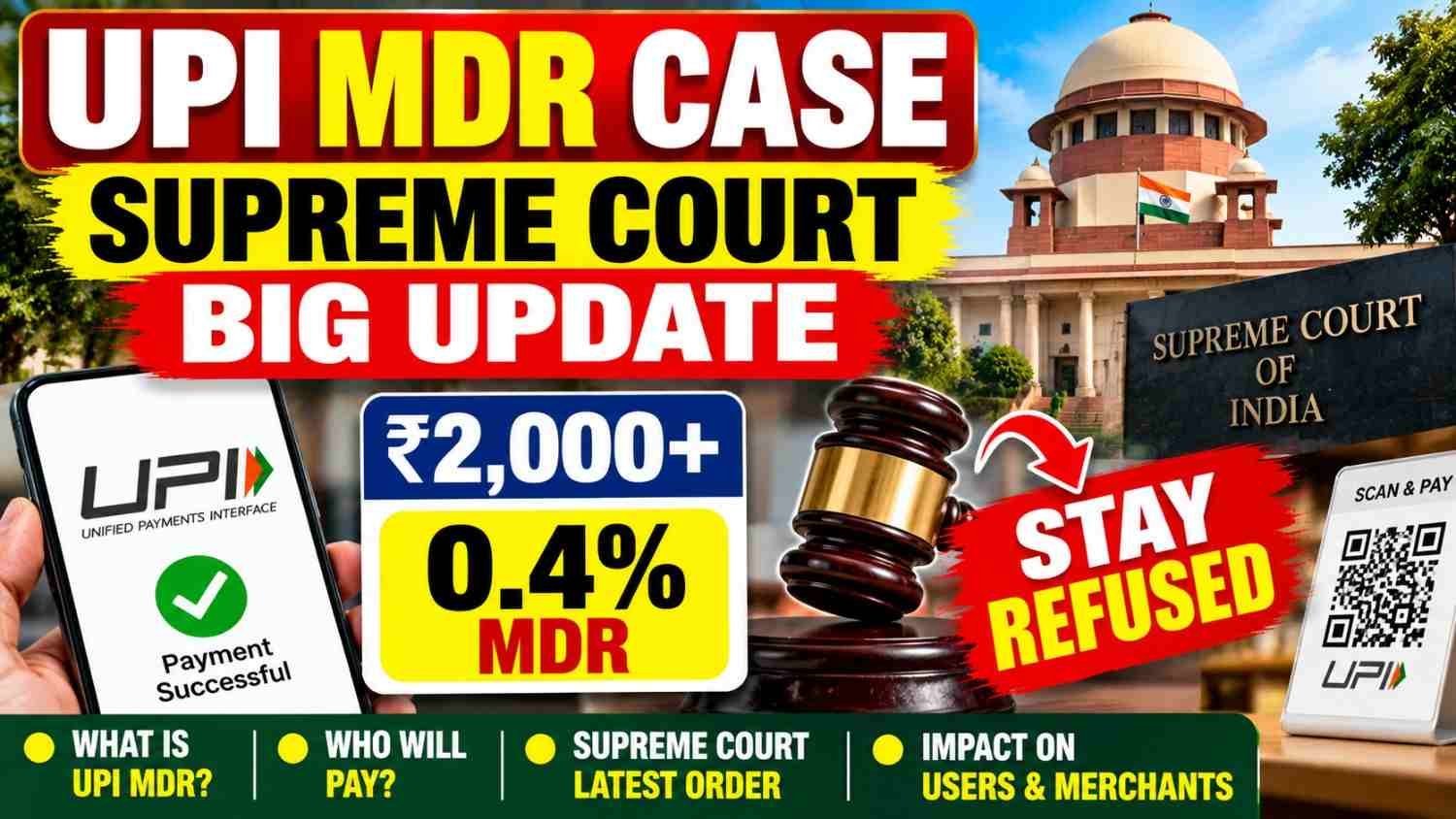
The UPI MDR Supreme Court Case has become an important development in India’s digital payments sector after the Supreme Court on 28 September 2026 refused to grant an interim stay on the proposed Merchant Discount Rate (MDR) for specified UPI merchant transactions above ₹2,000.
The Supreme Court has, however, sought responses from the Union Government, Reserve Bank of India (RBI), National Payments Corporation of India (NPCI) and other respondents on the legal and factual basis of the new MDR framework. The Court’s latest order therefore does not represent a final decision on whether the framework is legally valid.
The proposed framework is scheduled to take effect from 15 October 2026. Under the announced structure, a standard MDR of 0.4% will apply to specified person-to-merchant (P2M) UPI transactions above ₹2,000, subject to applicable exemptions, sector-specific rates and a maximum cap of ₹300 for transactions of ₹75,000 and above.
UPI MDR Supreme Court Case: What Happened on 28 September 2026?
In the latest hearing, a three-judge Supreme Court Bench comprising Chief Justice of India Surya Kant and Justices Joymalya Bagchi and V. Mohana heard a petition challenging the new UPI MDR framework.
The Court declined to put the framework on hold at the interim stage. At the same time, it asked the Centre and other respondents to explain the basis of the proposed charge and issued notices to the relevant authorities. Reports of the hearing state that the respondents were directed to file their responses/affidavits within four weeks.
The Court particularly examined the legal character of MDR and questioned the basis on which the charge is being imposed. Justice Joymalya Bagchi asked whether the amount should be treated as a tax or fee and, if not, what the executive basis for the charge was.
This means the UPI MDR Supreme Court Case is still pending. The Court has not delivered a final judgment striking down or confirming the framework.
UPI MDR Supreme Court Case: Who Filed the Petition?
The petition was filed by advocate Anjan Datta, with the challenge directed against the Union Government’s decision to permit MDR on specified UPI merchant transactions above ₹2,000.
The petition challenges the September 2026 notifications and framework that changed the earlier zero-MDR protection applicable to UPI. The case is reported as Anjan Datta v. Union of India & Ors., Writ Petition (Civil) No. 1199 of 2026.
The petitioner has questioned, among other things, the legal basis for the charge, the manner in which the thresholds were established and the framework’s potential effect on merchants and consumers. The petition also raises questions concerning the amended Section 10A of the Payment and Settlement Systems Act, 2007.
UPI MDR Supreme Court Case: What Is MDR?
MDR stands for Merchant Discount Rate.
It is a payment-processing charge associated with accepting digital payments. In the new UPI framework, the MDR is intended to be borne within the merchant-payment ecosystem rather than being a direct charge imposed on the person making the UPI payment.
The government has stated that MDR is not a tax collected by the Government and that the amount is distributed among participants in the payment ecosystem, including banks and payment service providers.
The distinction is important because the UPI MDR Supreme Court Case is examining, among other questions, the legal character and basis of this charge.
UPI MDR Supreme Court Case: What Is the 0.4% UPI Charge?
Under the framework announced by the authorities, the standard MDR for specified P2M UPI transactions above ₹2,000 is 0.4%.
For example:
- ₹2,000 UPI merchant payment: no standard MDR under the threshold.
- ₹3,000 eligible transaction: 0.4% MDR = ₹12.
- ₹10,000 eligible transaction: 0.4% MDR = ₹40.
- ₹50,000 eligible transaction: 0.4% MDR = ₹200.
- ₹75,000 or more: MDR is capped at ₹300 under the standard structure.
The official NPCI FAQs state that the new framework is scheduled to become effective from 15 October 2026.
UPI MDR Supreme Court Case: Will Customers Have to Pay the MDR?
According to the Government’s announced framework, customers are not supposed to directly pay the MDR.
The MDR is structured as a merchant-side payment-processing charge. The Finance Ministry has also advised banks to ensure that merchants do not recover the MDR from customers. UPI application providers are also prohibited under the framework from imposing platform fees or hidden charges on UPI payments.
However, the economic impact on consumers is one of the issues discussed in the legal challenge. The petitioner has argued that merchants could potentially respond to additional payment costs through pricing or by changing payment-acceptance practices. The Supreme Court has not yet given a final ruling on these arguments.
UPI MDR Supreme Court Case: Will UPI-to-UPI Transfers Become Chargeable?
No.
Under the current announced framework, person-to-person (P2P) UPI transfers remain free, regardless of the amount transferred.
For example, if one individual sends ₹5,000 to another individual through UPI, the new merchant MDR framework does not apply to that P2P transaction.
The Department of Financial Services has specifically stated that P2P transactions will remain free.
UPI MDR Supreme Court Case: Are UPI Payments Below ₹2,000 Free?
Yes, the notified framework protects UPI transactions up to ₹2,000 from charges by banks or system providers under Section 10A of the Payment and Settlement Systems Act.
The Ministry of Finance issued Notification S.O. 5067(E) on 14 September 2026 specifying RuPay-powered debit cards and UPI transactions up to ₹2,000 as the electronic modes covered by the no-charge protection.
The subsequent MDR framework deals with specified transactions above the ₹2,000 threshold.
UPI MDR Supreme Court Case: What Happens to Small Merchants?
Small merchants have been given specific protection under the announced framework.
According to the official FAQs, merchants covered under the Person-to-Person-Merchant (P2PM) category and receiving up to ₹1 lakh per month through UPI QR directly into their bank accounts will continue under the zero-MDR framework.
The policy therefore does not mean that every shopkeeper accepting UPI will automatically start paying 0.4% on every transaction.
The exact classification of a merchant and the applicable transaction category remain important.
UPI MDR Supreme Court Case: How Many UPI Transactions Will Remain Unaffected?
The government has said that approximately 96% of merchant UPI transactions will remain unaffected.
This is because person-to-person transactions remain free, merchant payments up to ₹2,000 remain protected, and certain small merchants and specified categories receive separate exemptions or concessional treatment.
The government has described the new MDR framework as a limited charge applicable to specified higher-value merchant transactions rather than a general charge on UPI.
UPI MDR Supreme Court Case: What Are the Special MDR Rates?
The standard rate is not the only rate under the new framework.
The official information provides different treatment for certain categories.
Specified essential sectors such as fuel, agricultural inputs and other designated categories can attract a flat ₹5 MDR for transactions above the relevant threshold.
Capital-market transactions involving areas such as mutual funds, securities, stockbrokers and dealers have a separate 0.02% MDR, subject to a maximum cap of ₹300.
This is one reason the Supreme Court case involves more than simply asking whether a 0.4% charge exists. The framework contains multiple transaction categories, exemptions, thresholds and caps.
UPI MDR Supreme Court Case: Why Did the Government Introduce MDR?
The Government and NPCI have explained the policy primarily in terms of the long-term sustainability of the UPI ecosystem.
According to the official explanation, MDR revenue will remain within the payment ecosystem and can support areas such as infrastructure resilience, innovation, cybersecurity and customer service.
The Government has also said that the framework is intended to reduce reliance on other mechanisms for supporting the cost of the rapidly expanding digital-payment infrastructure.
The Supreme Court is now examining the legal and factual basis of this framework in response to the petition.
UPI MDR Supreme Court Case: Why Is the Legal Basis Being Questioned?
One of the important issues raised during the hearing concerns the legal source and character of the MDR.
The Centre’s Additional Solicitor General N. Venkataraman told the Court that the amount was not a tax or government fee and that the Government itself would not receive the money. According to the Centre’s position, it is a settlement charge within the payment ecosystem involving banks and service providers.
The Court nevertheless sought the relevant facts and legal explanation on affidavit.
This distinction is central to the UPI MDR Supreme Court Case, because the Court is examining the legal incidence and basis of the charge rather than simply deciding whether UPI should have a commercial pricing model.
UPI MDR Supreme Court Case: What Is the Role of Section 10A?
Section 10A of the Payment and Settlement Systems Act, 2007 is an important part of the dispute.
The 2026 legislative amendment changed the wording of Section 10A. The earlier provision was linked to electronic payment modes prescribed under Section 269SU of the Income-tax Act, 1961.
The amended provision instead allows the Central Government to specify, through notification, one or more electronic payment modes to which the no-charge protection applies.
On 14 September 2026, the Ministry of Finance used this framework to specify RuPay debit cards and UPI transactions up to ₹2,000 for the no-charge protection.
The petitioner has challenged the legal framework and the subsequent MDR structure.
UPI MDR Supreme Court Case: What Did the Supreme Court Actually Decide?
The most important point is that the Supreme Court did not finally decide the legality of MDR on 28 September 2026.
The Court:
- Refused the request for an interim stay.
- Issued notice to the Centre and other respondents.
- Sought responses from the relevant authorities.
- Asked for factual and legal clarification regarding the MDR framework.
- Did not quash the September notifications.
- Did not give a final judgment declaring the MDR framework valid or invalid.
Therefore, headlines saying that the Supreme Court has “approved” UPI MDR would be misleading at this stage.
Similarly, saying that the Supreme Court has “cancelled” the UPI MDR would also be incorrect.
UPI MDR Supreme Court Case: When Will the New MDR Framework Start?
Unless the framework is changed, stayed or otherwise modified before implementation, the announced MDR provisions are scheduled to take effect on 15 October 2026.
The Supreme Court’s 28 September decision did not grant an interim stay.
Therefore, businesses should continue to follow official notifications and instructions from the Government, RBI, NPCI and their acquiring banks rather than relying on social-media claims about the case.
UPI MDR Supreme Court Case: What Does It Mean for Ordinary UPI Users?
For ordinary consumers, the current framework means:
- P2P UPI transfers remain free.
- UPI merchant payments up to ₹2,000 remain protected.
- Customers are not supposed to be directly charged the MDR.
- UPI apps are not supposed to add hidden platform charges under the announced framework.
- The proposed MDR primarily concerns specified merchant-side transactions above ₹2,000.
Therefore, the headline “UPI will become paid from October 15” is too broad.
The actual framework is more specific and contains several exemptions and special categories.
UPI MDR Supreme Court Case: What Does It Mean for Shopkeepers?
The effect on merchants depends on their category, transaction value and monthly UPI receipts.
A merchant receiving eligible payments above ₹2,000 may face the applicable MDR from 15 October 2026.
For example, a qualifying ₹10,000 transaction at the standard 0.4% rate would generate an MDR of ₹40 before considering applicable tax treatment.
At ₹75,000 and above, the standard MDR is capped at ₹300 per transaction.
Small merchants covered by the P2PM zero-MDR framework have separate protection.
Businesses should therefore confirm their merchant classification and applicable MDR with their acquiring bank or payment service provider before implementation.
UPI MDR Supreme Court Case: Will GST Apply to MDR?
GST treatment concerns the MDR amount, not the full value of the UPI payment.
For example, if an eligible ₹10,000 transaction carries an MDR of ₹40, an 18% GST calculation on the MDR would be ₹7.20, making the payment-processing cost ₹47.20 for the merchant, subject to the applicable rules, exemptions and tax status of the merchant.
This should not be confused with charging 18% GST on the entire ₹10,000 UPI transaction.
Businesses should rely on their tax adviser and applicable GST guidance for their specific circumstances.
UPI MDR Supreme Court Case: What Are the Main Issues Before the Court?
The UPI MDR Supreme Court Case raises several interconnected questions.
The major issues include:
- What is the precise legal character of MDR?
- What is the statutory basis for imposing the charge?
- How does the amended Section 10A operate?
- What is the scope of the executive’s authority under the amended law?
- What is the legal basis for the ₹2,000 threshold?
- What is the basis for the ₹1 lakh monthly threshold for small merchants?
- How were different sector-specific MDR rates determined?
- What safeguards exist against the MDR being passed on to consumers?
- How should the interests of merchants, payment providers and the wider digital-payment ecosystem be balanced?
The Court has not yet finally answered these questions.
UPI MDR Supreme Court Case: What Happens Next?
The next stage will involve responses from the Union Government, RBI, NPCI and other respondents.
The Court has asked the authorities to place relevant information and explanations before it. Once those responses are filed, the Supreme Court can consider the legal challenge in greater detail.
Until a final order is passed, the 28 September hearing should be understood as an interim procedural development, not the final outcome of the case.
UPI MDR Supreme Court Case: Important Dates to Remember
14 September 2026: Ministry of Finance issued Notification S.O. 5067(E), protecting specified UPI transactions up to ₹2,000 and RuPay debit-card payments from charges under Section 10A.
15 September 2026: Government and NPCI announced the detailed MDR framework for select UPI P2M transactions.
28 September 2026: Supreme Court refused interim stay and sought responses from the Centre and other authorities.
15 October 2026: Scheduled implementation date for the new MDR framework, unless modified by subsequent government action or court orders.
UPI MDR Supreme Court Case: Frequently Asked Questions
UPI MDR Supreme Court Case: Is UPI going to become completely paid?
No. The announced framework does not impose a universal charge on every UPI transaction. P2P transactions remain free, UPI merchant payments up to ₹2,000 remain protected, and certain small merchants and transaction categories receive exemptions or concessional rates.
UPI MDR Supreme Court Case: Will customers pay 0.4% MDR?
The announced framework places MDR on the merchant/payment ecosystem, not directly on customers. The Government has also advised banks that merchants should not pass the MDR to customers.
UPI MDR Supreme Court Case: What is the standard MDR rate?
For specified P2M transactions above ₹2,000, the standard MDR is 0.4%, with a ₹300 cap for transactions of ₹75,000 and above. Certain sectors have different rates.
UPI MDR Supreme Court Case: Does the Supreme Court support the MDR?
The Court has not given a final ruling supporting or rejecting the MDR. On 28 September 2026, it refused an interim stay and sought responses from the authorities.
UPI MDR Supreme Court Case: Can I still use UPI normally?
Yes. UPI continues to operate. P2P transactions remain free, and the announced MDR framework is scheduled to apply to specified merchant transactions from 15 October 2026.
UPI MDR Supreme Court Case: Will small shopkeepers have to pay MDR?
Not necessarily. Merchants covered by the P2PM zero-MDR framework, including eligible small merchants receiving up to ₹1 lakh per month through UPI QR directly into their accounts, are protected under the announced framework.
UPI MDR Supreme Court Case: Has the case been finally decided?
No. The 28 September hearing did not produce a final judgment. The Supreme Court has sought responses and the legal challenge remains pending.
UPI MDR Supreme Court Case: Final Conclusion
The UPI MDR Supreme Court Case is now an important legal development surrounding the future pricing structure of India’s digital-payment ecosystem.
The Supreme Court’s latest decision is clear in one respect: there is no interim stay on the announced MDR framework at present. At the same time, the Court has sought detailed responses concerning the legal and factual basis of the charge.
The proposed framework is scheduled to begin on 15 October 2026, with a standard 0.4% MDR on specified P2M UPI transactions above ₹2,000, subject to caps, exemptions and sector-specific rates.
For consumers, P2P UPI payments remain free and customers are not supposed to be directly charged the MDR. For merchants, the effect depends on their category and transaction profile.
The final legal position will depend on the Supreme Court’s subsequent proceedings and orders. Readers and businesses should therefore check the latest official updates from the Supreme Court, Ministry of Finance, RBI and NPCI before making decisions based on the case.
Disclaimer: This article is for general informational purposes and reflects publicly available information available as of 28 September 2026. It is not legal, tax, financial or professional advice. The Supreme Court proceedings are ongoing, and the framework may be affected by subsequent court orders, government notifications or regulatory directions.